2026 GMC Sierra 1500 or 2026 GMC Canyon: Which GMC Truck Is Right for Saskatchewan?
Choosing between the Sierra 1500 and the Canyon usually comes down to one question: how big does the job actually get? Both trucks carry the GMC badge into work sites, gravel roads, and cabin trips across Saskatchewan, but they solve different problems. This comparison looks at footprint, cab and bed space, towing and payload, powertrain […]
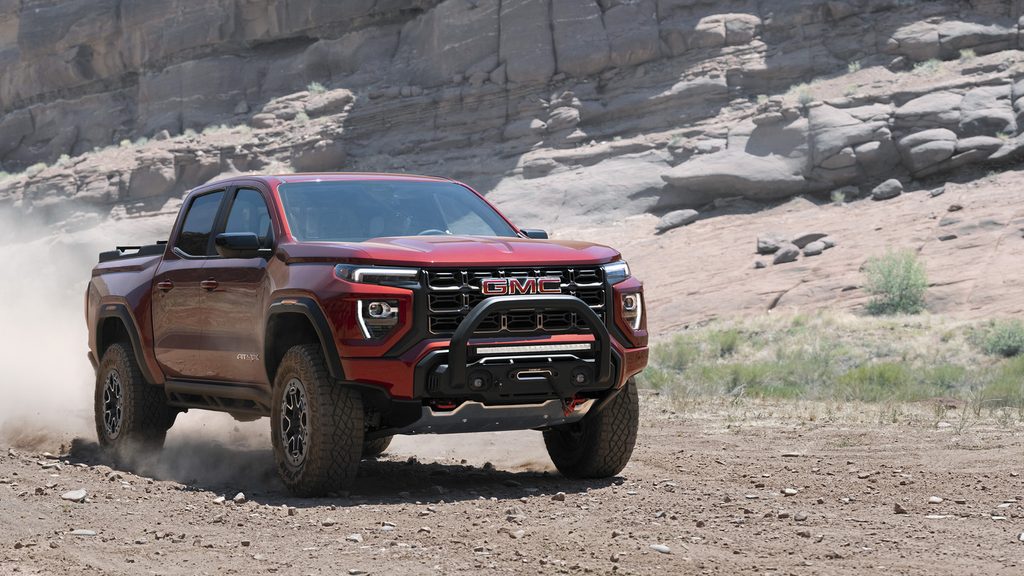
Choosing between the Sierra 1500 and the Canyon usually comes down to one question: how big does the job actually get? Both trucks carry the GMC badge into work sites, gravel roads, and cabin trips across Saskatchewan, but they solve different problems.
This comparison looks at footprint, cab and bed space, towing and payload, powertrain choice, off-road hardware, and cabin tech, so you can match the truck to the way you actually drive.
Sierra 1500 vs Canyon: Side-By-Side Specs
| Spec | Sierra 1500 | Canyon |
| Body style | Full-size, Crew Cab | Midsize, Crew Cab |
| Overall length | 5,891 mm | 5,415 mm |
| Wheelbase | 3,734 mm | 3,327 mm |
| Cargo box length | 1,776 mm | 1,567 mm |
| Cargo volume | 1,781 L | 1,186 L |
| Fuel tank capacity | 91 L (24 gal) | 81 L (21 gal) |
| Seating capacity | Up to 6 | 5 |
| Ground clearance (AT4 / AT4X) | 282 mm / 292 mm | 244 mm / 272 mm |
| Standard engine | 2.7 L TurboMax I4, 310 hp / 430 lb-ft | 2.7 L TurboMax I4, 310 hp / 430 lb-ft |
| Available engines | 5.3 L V8, 6.2 L V8, 3.0 L Duramax diesel | Not offered |
Footprint: City Parking, Rural Roads, and Tight Job Sites
The Sierra 1500’s 5,891 mm length and 3,734 mm wheelbase give it a wide stance built around trailer stability and cargo room. That size pays off on the highway and around a loaded jobsite, but it also means a longer turn and a bigger parking spot.
The Canyon trims 476 mm off overall length and 407 mm off wheelbase compared with the Sierra 1500. For grocery runs, downtown errands, or a farmyard with tighter turnarounds between buildings, that shorter footprint is easier to place.
Cab, Bed, and Passenger Room
Sierra 1500 Crew Cab models seat up to six with a front bench where equipped, while Canyon tops out at five seats across its lineup. If you regularly carry a full crew, the Sierra’s extra seating capacity matters.
Bed volume tells a similar story. The Sierra 1500’s box measures 1,776 mm long with 1,781 L of cargo volume. The Canyon’s box runs 1,567 mm with 1,186 L. Sheet goods, long ladders, or bulky camping gear fit more easily in the Sierra’s longer box.
Towing, Payload, and Bed Utility
On the Sierra 1500, towing figures shift with trim and engine. Pro models are rated up to 13,200 lbs (5,987 kg), AT4 tops out at 9,000 lbs (4,082 kg), and Denali reaches 9,400 lbs (4,264 kg). Payload runs from 992 kg on Pro up to 2,372 lbs (1,076 kg) on AT4, with SLT at 1,037 kg and Denali at 1,031 kg.
The Canyon’s payload varies by trim too: Elevation carries 886 kg (1,953 lbs (886 kg)), AT4 and AT4X carry 775 kg (1,708 lbs (775 kg)), and Denali carries 694 kg (1,530 lbs (694 kg)). Every Canyon trim comes standard with an integrated trailer brake controller and Blind Zone Steering Assist with Trailering, so hitching up a utility trailer or a set of side-by-sides is well supported even without full-size towing numbers.
For readers who tow a fifth wheel, a large enclosed trailer, or heavy equipment regularly, the Sierra 1500’s towing range is built for that job. For lighter, occasional trailering, the Canyon’s standard trailering hardware covers the task without the full-size footprint.
Powertrain Lineup and Diesel Availability
Here is where the two trucks split hardest. The Sierra 1500 offers four engines: the 2.7 L TurboMax I4 (310 hp, 430 lb-ft), the 5.3 L EcoTec3 V8 (355 hp, 383 lb-ft), the 6.2 L EcoTec3 V8 (420 hp, 460 lb-ft), and the 3.0 L Duramax turbo-diesel I6 (305 hp, 495 lb-ft).
The Canyon runs a single engine across its entire lineup, the same 2.7 L TurboMax I4 rated at 310 hp and 430 lb-ft, paired with an 8-speed automatic. There is no diesel or V8 option on Canyon.
Fuel economy reflects that gap. Sierra 1500 4WD models with the 2.7 L TurboMax post 14.2 L/100 km city and 12.9 L/100 km highway. Canyon AT4 with the same engine posts 13.6 L/100 km city and 10.7 L/100 km highway, the lighter midsize body edging efficiency in the same powertrain. Sierra’s Duramax diesel drops further, to 10.7 L/100 km city and 9.3 L/100 km highway on AT4.
Fuel tank size follows the same pattern: 91 L (24 gal) on Sierra 1500 versus 81 L (21 gal) on Canyon, meaning the Sierra can stretch further between highway fuel stops on long Saskatchewan drives, even before factoring in the diesel’s lower consumption.
Off-Road Hardware and Ground Clearance
Both trucks offer AT4 and AT4X trims built for the same mission: get past the pavement. Sierra 1500 AT4 and AT4X share a two-speed Autotrac transfer case and a factory two-inch suspension lift, with AT4X adding Multimatic DSSV dampers and driver-selectable front and rear locking differentials. Ground clearance runs 282 mm on AT4 and 292 mm on AT4X.
Canyon AT4 and AT4X mirror that structure at midsize scale: a two-speed Autotrac transfer case on both, with AT4X adding front and rear full-locking differentials, DSSV dampers, and a Baja drive mode. Ground clearance measures 244 mm on AT4 and 272 mm on AT4X.
For a Saskatchewan buyer weighing backcountry trails or job sites reached by rough grid roads, both AT4X trims deliver locking differentials and tuned dampers. The Sierra’s numbers scale up with its larger frame; the Canyon delivers the same hardware philosophy in a smaller package.
Cabin Comfort and Tech
Canyon’s cabin runs an 11.3-inch GMC Premium Infotainment touchscreen with Google built-in, an 11-inch digital driver display, and a 6.3-inch head-up display standard on AT4X. Audio runs six speakers on AT4 and seven on AT4X, with interior trim moving from Cloth/CoreTec on AT4 to perforated leather on AT4X.
Sierra 1500 spans a wider comfort range, from work-focused cloth on Pro through to Denali Ultimate’s full leather cabin and available Super Cruise hands-free driving. Sierra also offers up to 14 camera views for trailer manoeuvring, useful when backing a longer trailer than most Canyon buyers would tow.
Which GMC Fits Your Drive?
If your week includes towing a fifth wheel, hauling a full crew, or loading long material into a longer box, the Sierra 1500’s cargo volume, seating for six, and engine range up to the 6.2 L V8 or Duramax diesel are built for that load.
If your days are shorter drives, tighter parking, and occasional trailering with a single utility trailer, the Canyon’s smaller footprint and standard ProGrade Trailering System cover that use case without the extra length to manage.
Both share the same off-road-ready AT4 and AT4X hardware philosophy, so the choice between them comes down to scale, not capability.
Finding the Right GMC Truck for You
The Sierra 1500 and Canyon each solve a different daily equation, from full-size towing and bed capacity to a midsize footprint that is easier to park and manoeuvre around a job site or driveway.
Visit Bridges Chevrolet Buick GMC in North Battleford to sit in both trucks, compare cab layouts in person, and talk through which GMC pickup matches your towing and hauling routine.