2026 Chevrolet Trax vs 2026 Toyota Corolla Cross: Why Trax Delivers More Everyday Value in Saskatchewan
Choosing between the 2026 Chevrolet Trax and the 2026 Toyota Corolla Cross usually comes down to how you use a compact SUV, not just the spec sheet. Saskatchewan shoppers cross-shop these two constantly this fall, and the differences show up fastest in cargo space, cabin feel, and how each engine responds around town. This comparison […]
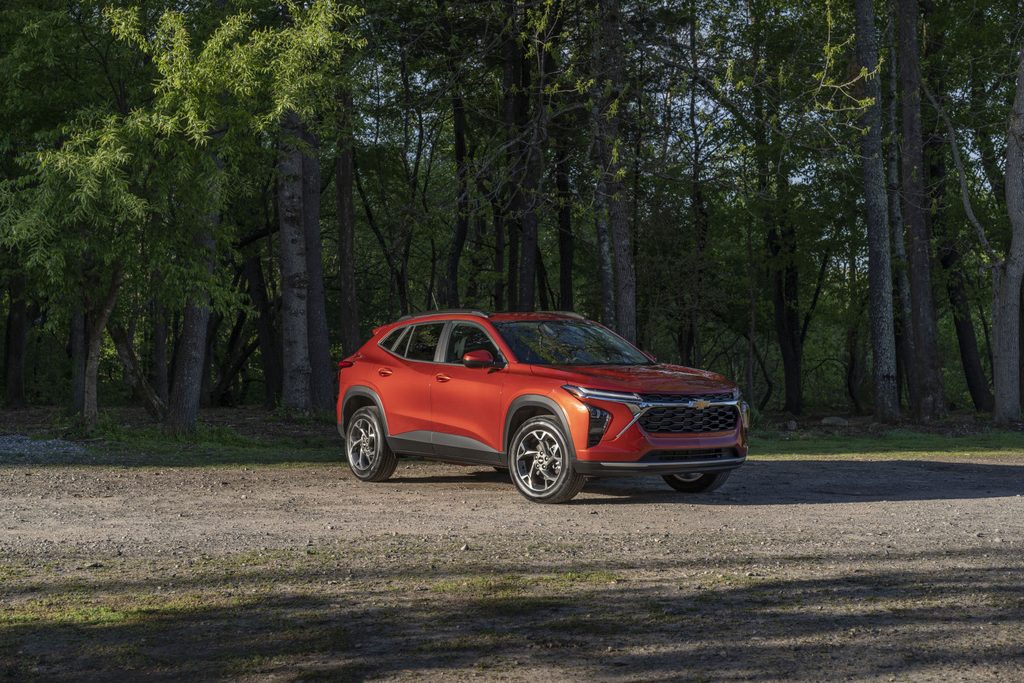
Choosing between the 2026 Chevrolet Trax and the 2026 Toyota Corolla Cross usually comes down to how you use a compact SUV, not just the spec sheet. Saskatchewan shoppers cross-shop these two constantly this fall, and the differences show up fastest in cargo space, cabin feel, and how each engine responds around town.
This comparison focuses on where the Trax pulls ahead, and where the Corolla Cross still holds its own, so you can see past trim badges to what each vehicle actually delivers day to day.
2026 Trax vs Corolla Cross: Key Specifications
| Spec | Chevrolet Trax | Toyota Corolla Cross |
| Cargo volume, seats folded | 1,532 L | 680 L (FWD) / 609 L (AWD) |
| Peak torque | 162 lb-ft | 151 lb-ft (gas) |
| Wheelbase | 2,692 mm | 2,639 mm |
| Largest factory wheel | 19-inch | 18-inch |
| Horsepower | 137 hp | 169 hp (gas) |
| Fuel economy, combined | 8.1 L/100km | 7.4 L/100km (FWD) / 7.8 L/100km (AWD) |
| Ground clearance | 185 mm | 208 mm |
| Towing capacity | Not rated to tow | 1,499 lbs (680 kg) (gas trims) |
| Drivetrain | FWD only | FWD standard, AWD available |
Cabin Space and Cargo Room That Does More
The Trax’s 2,692 mm wheelbase runs 53 mm longer than the Corolla Cross’s 2,639 mm, and that extra length shows up inside. Front headroom measures 1,006 mm, front legroom 1,064 mm, and front shoulder room 1,415 mm.
Rear-seat passengers get 983 mm of legroom and 968 mm of headroom, numbers that hold up for taller adults on shorter trips, not just kids in booster seats.
Cargo space is where the gap widens further. The Trax holds 725 L behind the rear seats and 1,532 L with the 60/40 split rear seats folded flat. The Corolla Cross tops out at 680 L folded on its FWD gas grades, and 609 L on AWD grades. That difference matters for anyone hauling hockey gear, strollers, or a weekend’s worth of camping equipment.
Turbocharged Torque vs the Corolla Cross’s Naturally Aspirated Four
The Trax runs a 1.2L turbocharged three-cylinder making 137 hp and 162 lb-ft of torque at 2,500 rpm, paired with a 6-speed automatic and front-wheel drive only. The Corolla Cross’s gas engine is a larger 2.0L four-cylinder rated at 169 hp and 151 lb-ft, mated to a CVT, with front-wheel drive standard and Toyota’s Dynamic Torque AWD system available on select grades.
The Corolla Cross’s four-cylinder makes more peak horsepower, but the Trax’s turbocharged torque arrives lower in the rev range, 162 lb-ft at 2,500 rpm versus the Corolla Cross’s 151 lb-ft. That earlier torque peak is what a driver feels pulling away from a stop or merging into traffic, before the Corolla Cross’s larger engine and CVT have wound up to their power band.
On paper, the Corolla Cross is the more efficient choice, rated at 7.4 L/100km combined on FWD gas grades (7.8 L/100km with AWD) against the Trax’s 8.1 L/100km. Its gas trims also add a 1,499 lbs (680 kg) tow rating, something the Trax isn’t built for. But the efficiency gap amounts to well under a litre per 100 km, a smaller everyday cost than the extra 850 L of cargo room the Trax carries with its seats folded down.
The Corolla Cross also offers AWD grades with 208 mm of ground clearance, compared with the Trax’s FWD-only setup and 185 mm. For buyers who need all-wheel traction or extra clearance, that’s a real difference. For most daily commuting and grocery runs, the Trax’s turbo torque and standard traction control cover the same ground without the added cost of all-wheel hardware.
Standard Technology, Wheels, and Everyday Details
The Trax’s LT trim, one step above the base 1RS, already includes an 11-inch touchscreen and 8-inch digital driver display, plus a 6-speaker audio system. The Corolla Cross’s gas grades start with an 8-inch touchscreen, moving to a 10.5-inch unit only on higher trims, and its 9-speaker JBL audio system is reserved for its top hybrid grade.
Wheel sizes tell a similar story. The Trax’s 2RS trim rides on 19-inch wheels, a size the Corolla Cross’s gas lineup doesn’t reach; its largest factory wheel is 18-inch, fitted to the XLE grade. At 4,536 mm long, the Trax is also longer overall than the Corolla Cross’s 4,474 mm, giving it a more substantial stance parked side by side.
Why the Trax Fits Compact-SUV Shoppers in Saskatchewan
For drivers who load up cargo more often than they chase outright horsepower, the Trax’s 1,532 L of folded cargo space and standard turbo torque make the stronger case. Its 11-inch touchscreen and 6-speaker audio arrive one trim above base, ahead of where the Corolla Cross offers comparable content.
Families hauling gear for weekend trips, commuters who want quicker throttle response in city traffic, and shoppers who want more feature content lower in the trim ladder will find the Trax lines up with how they actually use a compact SUV.
Seeing the 2026 Trax in Person
The 2026 Trax pairs a turbocharged three-cylinder engine with cargo space and feature content that stretches further down its trim lineup than many vehicles in the compact SUV segment.
Visit Bridges Chevrolet Buick GMC in North Battleford to sit inside the 2026 Trax, check the cargo area for yourself, and see which trim lines up with your daily routine.