Understanding the 2026 GMC Yukon vs Yukon XL: Which Full-Size SUV Is Right for You?
Choosing between the 2026 GMC Yukon and Yukon XL means understanding how wheelbase length affects everything from cargo capacity to daily driving. Both full-size SUVs deliver GMC’s signature blend of capability and premium comfort, but they’re designed for different needs. The standard Yukon measures 5,337 mm in overall length with a 3,073 mm wheelbase, while […]
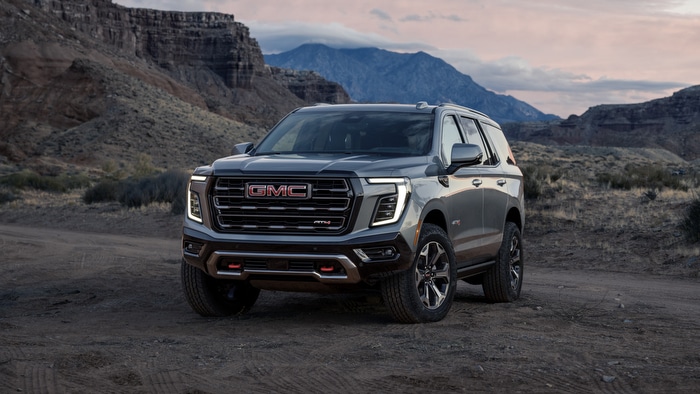
Choosing between the 2026 GMC Yukon and Yukon XL means understanding how wheelbase length affects everything from cargo capacity to daily driving. Both full-size SUVs deliver GMC’s signature blend of capability and premium comfort, but they’re designed for different needs.
The standard Yukon measures 5,337 mm in overall length with a 3,073 mm wheelbase, while the Yukon XL extends to 5,720 mm with a 3,404 mm wheelbase. That extra length translates directly into more cargo room and third-row legroom – critical considerations for families who regularly carry passengers or gear. Both share the same width, powertrain options, and trim levels, making the choice primarily about interior space versus parking convenience.
At a Glance: Yukon vs Yukon XL Key Differences
| Feature | 2026 GMC Yukon | 2026 GMC Yukon XL |
| Overall Length | 5,337 mm | 5,720 mm |
| Wheelbase | 3,073 mm | 3,404 mm |
| Third-Row Legroom | 886 mm | 932 mm |
| Cargo Volume (Seats Folded) | 3,477 L | 4,092 L |
| Fuel Tank Capacity | 91 L | 106 L |
| Max Towing Capacity | 3,810 kg (8,400 lbs) | 3,720 kg (8,200 lbs) |
Cargo Capacity and Interior Space
The Yukon XL’s extended wheelbase delivers 615 litres more maximum cargo volume than the standard Yukon – 4,092 litres versus 3,477 litres with all seats folded. Behind the third row, the XL offers 1,175 litres compared to the Yukon’s 722 litres, a difference that matters when hauling luggage or sports equipment with all seats occupied.
Third-row passengers benefit from the XL’s extra length. The extended model provides 932 mm of third-row legroom versus 886 mm in the standard Yukon – enough to make long trips more comfortable for adults or growing teenagers. First- and second-row dimensions remain identical between both models, with 1,074 mm of front headroom and 1,067 mm of second-row legroom across the lineup.
Both SUVs seat eight passengers in Elevation and AT4 trims, or seven in Denali configurations with second-row captain’s chairs. The power-folding third-row bench is standard across all trims, making it easy to configure cargo space as needed.
Powertrain Options and Performance
Both the Yukon and Yukon XL offer identical engine choices across all five trim levels. The 5.3L V8 engine is standard on Elevation and AT4 trims, delivering 355 hp and 383 lb-ft of torque. Denali and top-tier trims come standard with the 6.2L V8, producing 420 hp and 460 lb-ft of torque.
All engines pair with a 10-speed automatic transmission and standard four-wheel drive. The available 3.0L Duramax Turbo-Diesel serves as a strong alternative across the entire lineup, generating 305 hp and 495 lb-ft of torque. This engine excels at towing and highway cruising, though it will arrive later in the model year.
Fuel economy differs slightly between the two models. The standard Yukon with the 5.3L V8 achieves 15.8 L/100 km city and 12.2 L/100 km highway, while the XL returns 17.1 L/100 km city and 12.6 L/100 km highway. The larger fuel tank in the Yukon XL – 106 litres versus 91 litres – helps offset the slightly higher consumption on long trips.
Trim Levels and Features
Both models share the same five-trim structure: Elevation, AT4, Denali, AT4 top tier, and Denali top tier. Each trim offers the same standard equipment regardless of wheelbase length.
Elevation serves as the well-equipped entry point, featuring the 16.8-inch diagonal Premium GMC Infotainment Center, heated front seats, heated steering wheel, and LED headlamps with animated lighting. The Bose CenterPoint 10-speaker audio system is standard.
AT4 adds off-road capability with 20-inch all-terrain tires, Magnetic Ride Control suspension, available power-retractable assist steps, and Hill Descent Control. The AT4 top trim builds on this foundation with standard Air Ride Adaptive Suspension, massaging front seats, and Night Vision technology.
Denali models emphasize luxury with perforated leather seating, the 15-inch Head-Up Display, and premium interior finishes. Denali top trim stands as the pinnacle of the lineup, featuring standard 24-inch wheels, the Bose Performance Series 18-speaker audio system, massaging seats, and Super Cruise hands-free driver assistance.
Towing and Capability
Towing capacity differs slightly between the two models. The standard Yukon delivers 3,810 kg (8,400 lbs) when properly equipped, while the Yukon XL offers 3,720 kg (8,200 lbs). The standard ProGrade Trailering System includes features like Hitch View, Smart Trailer Integration, and available Transparent Trailer View technology that uses cameras to virtually see through compatible trailers.
Ground clearance varies by trim rather than wheelbase. AT4 and AT4 top-tier models offer 204 mm (8.0 inches) of ground clearance in the Yukon and 198 mm (7.8 inches) in the XL, while Denali top-tier trims sit slightly lower at 186 mm (7.3 inches) for both configurations.
The Autotrac 2-speed transfer case is standard on AT4 trims and available on others, providing selectable drive modes for different terrain. Electronic Limited-Slip Differential is available on AT4 and standard on top-tier trims, improving traction in challenging conditions.
Technology and Safety Features
Both Yukons come standard with an extensive suite of driver assistance technologies. HD Surround Vision, Enhanced Auto Parking Assist, Reverse Automatic Braking, and Intersection Auto Emergency Braking are included across all trims. Blind Zone Steering Assist is standard on most trims, with upgraded Blind Zone Assist with Trailering available or standard on higher trims.
Super Cruise hands-free driver assistance is available on Elevation, AT4, and Denali trims, and comes standard on both top-tier models. The system includes a three-year trial period and works on compatible highways across Canada.
Night Vision technology, available exclusively on top-tier trims, uses thermal imaging to detect pedestrians and animals in low-light conditions, displaying alerts on the Head-Up Display and driver information center.
Which Model Fits Your Needs?
The standard Yukon suits drivers who want full-size capability in a more manageable package. Its shorter wheelbase makes parking easier in urban environments, and the 91-litre fuel tank is sufficient for most driving patterns. The 3,477 litres of maximum cargo space handles family trips and weekend adventures without issue.
The Yukon XL makes sense for families who regularly use the third row with adults or older children, or who need maximum cargo capacity for extended trips or recreational equipment. The extra 615 litres of cargo space and improved third-row legroom justify the additional length for buyers who prioritize interior volume over parking convenience.
Both models offer nearly identical towing capacity, the same powertrain options, and available features, so the decision comes down to interior space requirements and daily driving conditions.
Experience the 2026 GMC Yukon Lineup
Both the 2026 GMC Yukon and Yukon XL deliver the capability, technology, and premium comfort that define GMC’s flagship SUV. Whether you choose the standard wheelbase or extended length depends on your specific cargo and passenger needs. Visit our team to explore both models and determine which configuration best fits your lifestyle.